The thing about stories told in Appalachia is that no one ever claims to be the one to invent them. We inherit them; they are passed down to us like Mammaw’s dishes. (That’s pronounced ma’am- maw for those non-locals.) It’s information we learn by growing up here just like we know which areas flood first in heavy rain, and which roads are most dangerous when it snows. That’s how stories of the White Things are. They’re only discussed when necessary, and even then, only in hurried, hushed tones.
The White Things go by many names. You might also know them as White Devils, The Morgan Ridge Monster, The Kanawha County Creature, or their more modern moniker: the Sheepsquatch. They are an unusual and elusive creature, and only a few encounters with them have been officially documented.
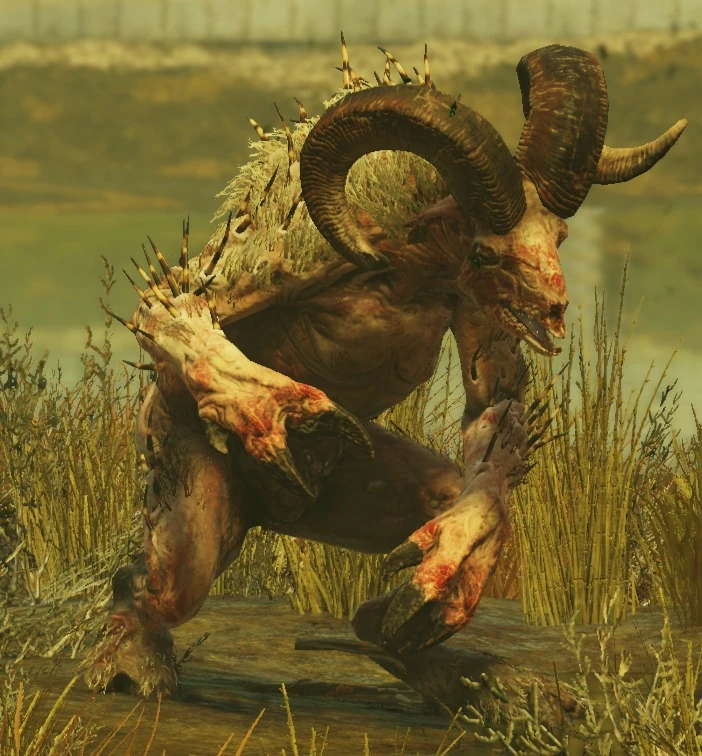
They are said to be the size of a large bear, and mostly quadrupedal but with the ability to stand and walk upright. They have shaggy, wooly-like, dirty white fur, a head shaped like something between a grizzly bear and a goat, and a mouth of razor-sharp fangs. Two sets of eyes sit low on the sides of its head, but less goat-like, and more like the eyes you’d see on a buffalo. Their heads are crowned with two large ram-like horns. They have dexterous racoon-like hands with claws similar to a bear, and a long hairless tail like an opossum. The only sounds they make are a guttural snarl or a shrill, high-pitched shriek.
By most cryptid storytelling standards, the Sheepsquatch lore is quite young. The first sighting was reported in the Morgan Ridge area of Fairmont, West Virginia in 1929. Then again in Kanawha County, WV in 1954, Rivesville, WV in 1958, up into the Pennsylvania are in the 1970s, Point Pleasant, WV (yes, that Point Pleasant of Mothman notoriety) in 1973, Cross Lanes and Boone County, WV in the 1990s, and down into Breckenridge County, Kentucky in 2004.